Choosing well: spreadsheets, sellers, agents and the items themselves
Four choices before any money moves. Each one gets easier when you ask for numbers you can check.
A spreadsheet site that earns your attention
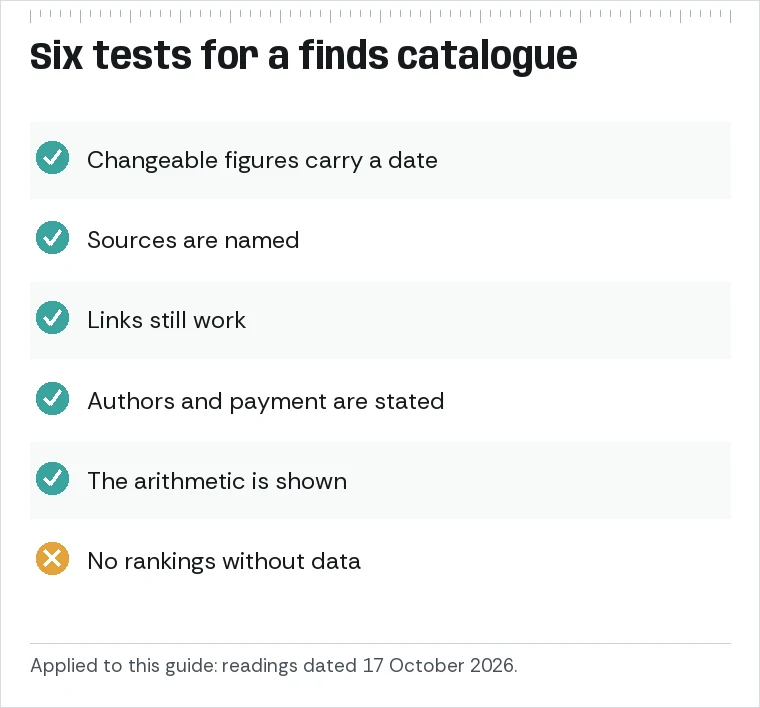
What makes a useful spreadsheet site is what it does with its numbers, since putting a catalogue online takes far less effort than keeping it current. A good one dates every figure that can change and tells you where it came from. It keeps its links working; dead links are the quickest sign that nobody is looking after it.
A catalogue that never shows a weight is not wrong, only incomplete: use it to discover items and take the weight from the listing. It says who writes it and whether it is paid for clicks. It shows its arithmetic, so you can repeat it. And it does not rank agents or products on data it cannot show you; a star score with no source is decoration.
Hold this site to the same list. Every reading here carries 17 October 2026, the method is on Line readings, the corrections address is in the footer, and the re-check date is on Updates.
Choosing a seller on the marketplaces Tigbuy buys from
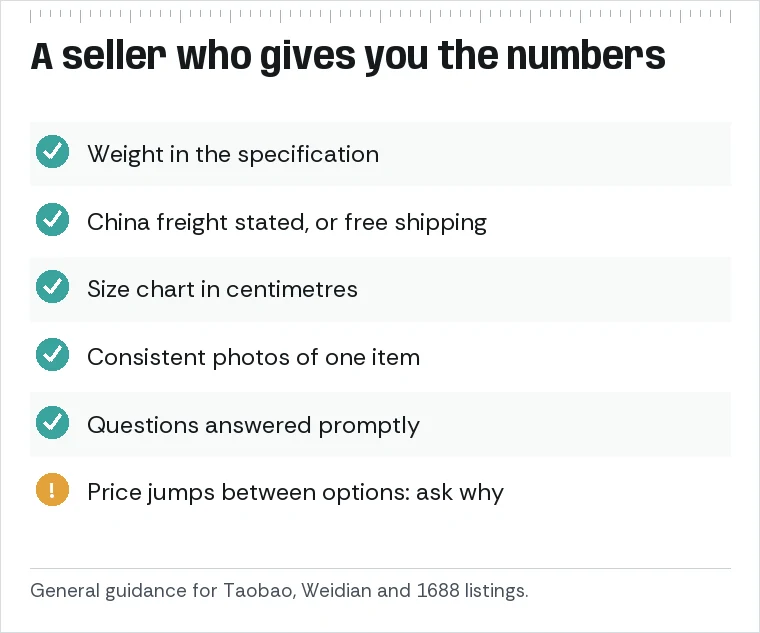
For the reading on this site, the best seller is one whose listing gives you the numbers. Look for a weight in the specification, a clear China freight charge or a free-shipping note, and garment measurements in centimetres.
Beyond the numbers, the usual signs still apply. Photos that look like the same item from several angles, not a collage of different ones. Answers to questions within a day or so. Sales and reviews on the platform that match the age of the shop. A seller who will tell you the weight with and without the box is worth a lot when the item is near a step boundary.
Avoid listings where the price changes sharply between colours or sizes without explanation; the price you base your reading on should be the one you will pay.
Judging an agent you are about to trust
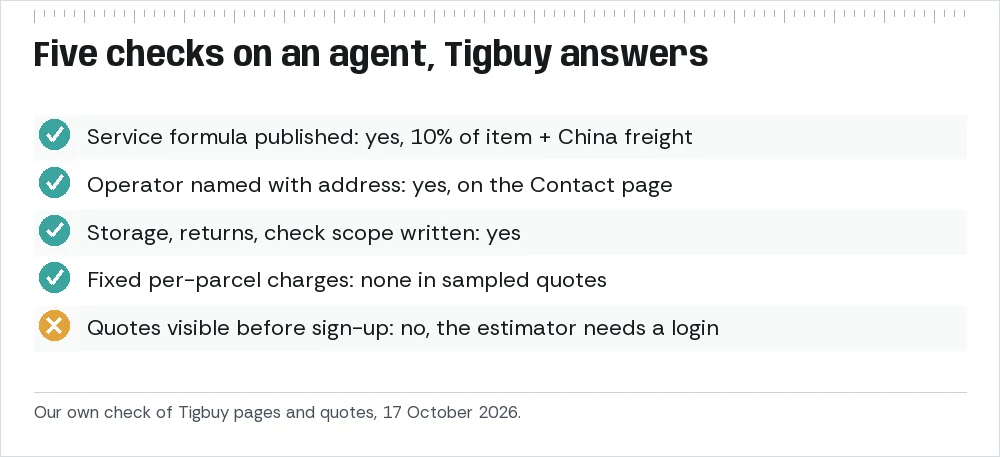
Choosing an agent comes down to what you can check before you send money. Is the service charge published as a formula, or only as a vague promise? Does the contact page name an operator with an address and a registration number? Are the storage period, return window and scope of the warehouse check written down?
Then look at a quote. Does it list every charge, and are any of them fixed per parcel? Can you see quotes before signing up? Tigbuy publishes its formula and operator, and its sampled quotes had no fixed charges; its estimator page, though, is only usable after signing in.
Contact routes are part of the same test. Tigbuy’s Contact page lists live chat hours and an email address, and its help centre carries the written rules; when you can find both in a few clicks, the agent is at least telling you how to hold it to account. An agent whose only contact is a chat widget with no written policies behind it asks for more trust than it shows.
A trustworthy agent is not one that promises the most. It is one whose written rules match what it charges, so that your own arithmetic comes out right. Comparing agents on that basis is more useful than any list of favourites.
How to choose an item when grams matter
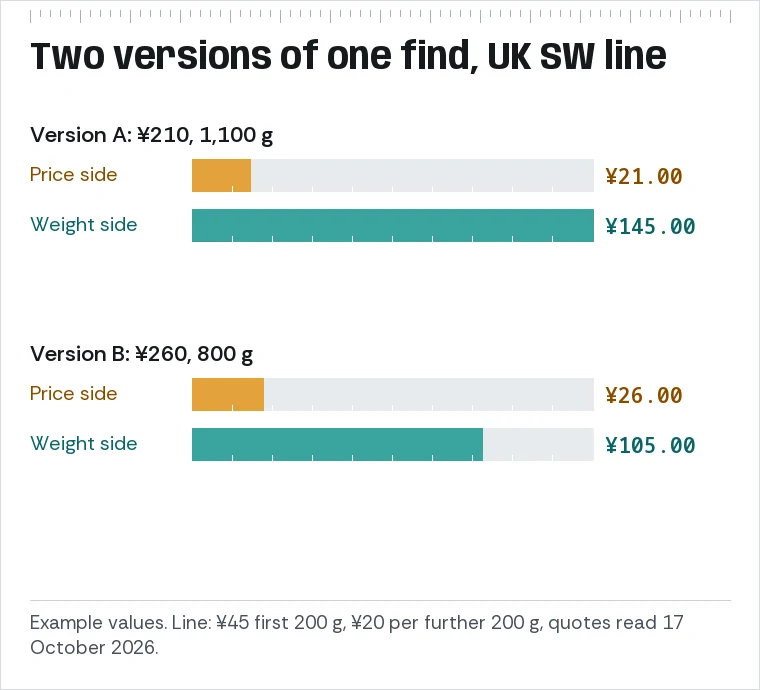
When two versions of a find look equally good, the price-per-gram reading can break the tie. For heavy finds, a lighter version saves on the weight side far more than a cheaper one saves on the price side. For light finds, the price matters more, and freight is mostly the first step of whatever line you use.
Picking the right item also means picking the right moment. If goods are already waiting in the warehouse, the per-gram view is a planning approximation; actual added freight still depends on the packed parcel, weight steps and line limits. If it would ship alone, it carries a whole first step. The dial shows both readings, so you can decide with the numbers in front of you.
If a listing offers the same item in two materials, the lighter one is not always cheaper to bring home once the price difference is counted; run both through the dial before deciding. And check the obvious: the size chart against a garment you own, the material against the season, the listing photos against the description.