The Tigbuy Spreadsheet catalogue, with a weight check for each shelf
Sixteen product categories to browse. For each one, the note says which detail on the listing decides its weight, because weight is the half of the cost a price tag does not show.
Every shelf in the catalogue, with a weight note
Sixteen illustrated categories, with checks to make before you divide price by grams. These are not measured category averages: actual weights vary between listings.
 JewelleryLook for the gram figure in the spec list
 BagsEmpty weight of the bag, not its carton
 T-shirtsCompare the price per gram across sizes
 HoodiesHeavier fabric shifts the reading
 OuterwearPadding and lining add grams
 JeansWaist and length move the weight
 SweatpantsFleece and cotton weigh differently
 WomenswearA keyword search, not a category
 SneakersCompare the size chart and sole measurements.
 Sports jerseysConfirm team, season, size and any personalisation.
 HatsCompare head circumference and adjustment.
 BeltsCheck usable length and buckle dimensions.
 EyewearConfirm frame width, lenses and included case.
 PerfumeConfirm liquid acceptance before paying.
 WatchesCheck case size, movement and battery restrictions.
 ElectronicsConfirm model, voltage, battery and route acceptance.
More checks before buying
- Trainers: Ask whether the weight includes the box
- Caps and hats: Check whether a packed weight is stated
- Football and team shirts: Badges and printing add a little weight
- Fragrance: Bottles are dense for their size; glass and liquid rules apply on some lines
- Watches: A small box can outweigh the watch itself
- Sunglasses and frames: The hard case is often most of the weight
- Belts: Buckles carry most of the grams
- Gadgets and audio: Battery items are restricted on many lines
Reading one catalogue entry in four numbers
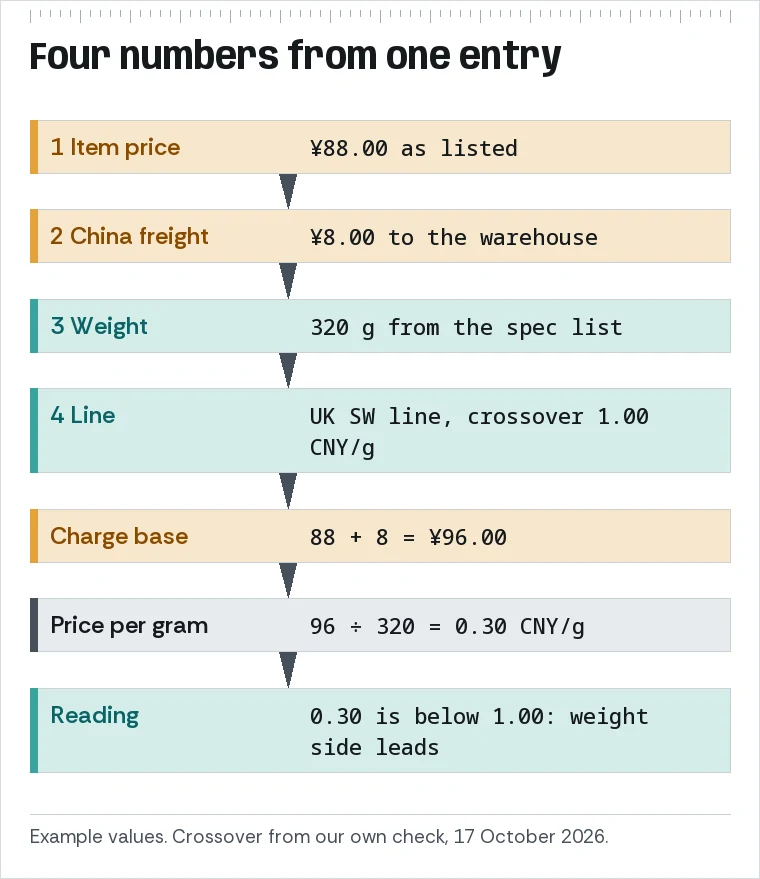
Open any entry and collect four things. The item price in yuan, as the seller lists it for the colour and size you want. The China freight, which is the seller’s delivery charge to Tigbuy’s warehouse and is often zero. The weight in grams, from the specification list, the description or a question to the seller. And the line you expect to use, which depends on where you live.
Add the first two and divide by the third: that is the price per gram, the figure the whole site turns on. Then compare it with the crossover of your line, listed on Line readings. Above the crossover, the ten percent service charge is the larger cost. Below it, freight is.
An example: an entry listed at ¥88 with ¥8 China freight and a stated weight of 320 g. Its charge base is ¥96, its price per gram 0.30 CNY/g. On a UK SW line with a 1.00 CNY/g crossover the weight side leads; on the same line a ¥260, 90 g piece would put the price side ahead.
Keep the figures rough at this stage. The listing weight is an estimate until Tigbuy weighs the parcel at the warehouse, which is covered on QC, weighing and arrival.
Do not let a calculation hide an unverified input
Start by selecting the exact seller option and quantity. Check whether the price is for one piece, a set or another variant, and whether any stated weight includes packaging. Keep the product link, measurements and material description. A visually identical item from a second shop can have a different construction, price or packed weight.
The Spreadsheet introduces possible purchases; the density dial explains the numbers you supply. Neither confirms the product’s quality or its final freight. If a weight is missing, treat the result as a scenario and label the assumption. Once the item reaches Tigbuy, replace that assumption with the appropriate warehouse or packed-parcel measurement before making a shipping decision.

Light, dear finds where the percentage leads
Small pieces with a high price per gram are where the ten percent starts to matter more than freight. Take an example ring at ¥300 that weighs 50 g: 6.00 CNY per gram, four times the US crossover. Averaged over the steps, it adds ¥7.50 of freight and ¥30.00 of service charge.
There is a catch that the per-gram reading hides. A find that ships alone pays the whole first step, and on the US line that step is ¥65. Up to 200 g, the price side only passes it once the charge base is above ¥650. Our example ring, sent on its own, still has a larger weight side.
So for light, dear finds the honest answer is “it depends how it travels”, and the dial shows both readings side by side. What does not change is the price side: ten percent of item plus China freight, whatever the line.
Heavy, cheap finds where the grams lead
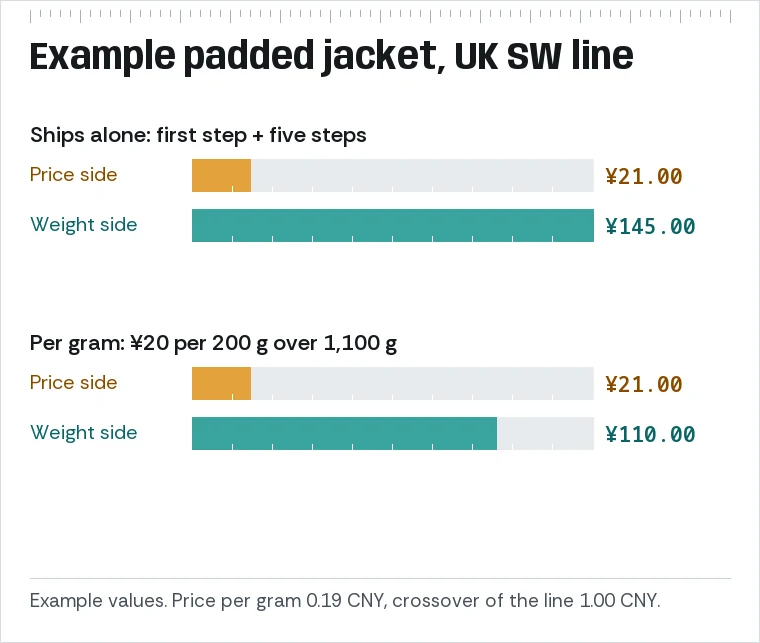
At the other end are bulky finds with a low price per gram. An example padded jacket listed at ¥210 with a stated weight of 1,100 g has a price per gram of 0.19 CNY, well under every crossover we sampled. Its service charge is ¥21.00. Shipped alone on a UK SW line with a ¥45 first step and ¥20 steps, its freight is ¥145.00, almost seven times the service charge.
For finds like this, the percentage barely moves the outcome. A membership rate a couple of points lower would save a yuan or two; a line with a lower step price, or a lighter version of the same item, changes the result by tens of yuan.
That is why weight notes on the shelves above talk about padding, lining and boxes. Those are the details that decide the larger side for heavy finds.
Where the gram figure comes from
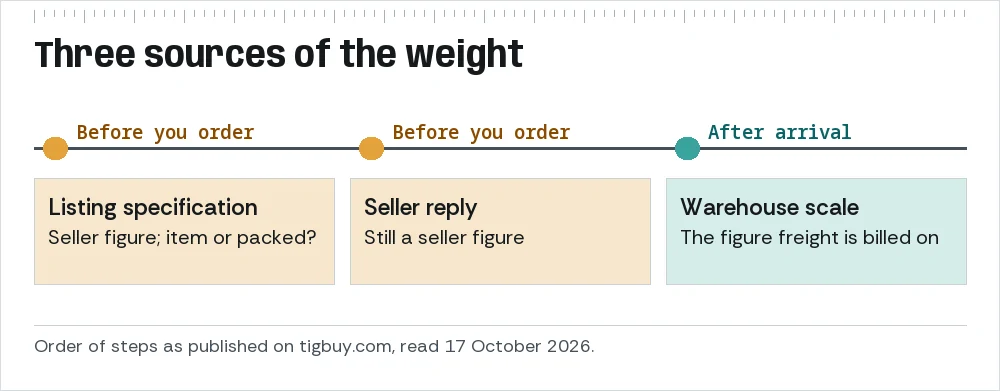
There are three places a weight can come from, and they arrive at different times. The listing specification is there before you order, and it is a seller’s figure, sometimes for the item and sometimes for the item in its packaging. A seller can answer a question about it, which is still their figure. The third is Tigbuy’s own scale: its home page lists quality inspection and weighing as the step after goods arrive at the warehouse.
The warehouse item weight is a better input than a listing estimate, but parcel billing can include packaging, dimensional weight and rounding. Treat any price-per-gram reading made from a listing as provisional, and re-run it on the warehouse figure before you choose a line.
Two more things can change the billed weight: the packaging added for the journey and, on lines that charge by box size, the size of the box. The dial works on actual grams only, so leave a margin for both.