Weight side: how a Tigbuy line turns grams into yuan
The second half of every reading. Freight follows the grams in whole steps, so it is the half that can jump when a find gets slightly heavier.
A first step, then steps of the same size
Every line sampled on 17 October 2026 bills a first step that covers anything up to 200 g, then charges a further step for each 200 g or part of 200 g after that. One UK SW line uses 199 g steps instead.
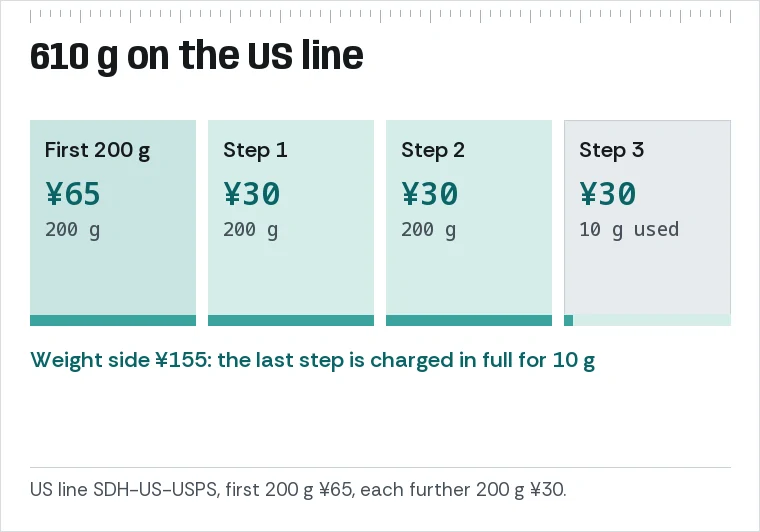
Rounding is always upwards. A 610 g find on the US line is billed as the first 200 g plus three steps, because the 410 g beyond the first step is more than two steps: ¥65 plus three times ¥30, ¥155. At 600 g it would be two steps and ¥125.
This is why the dial asks for grams and not kilograms. A difference of ten grams can be worth a full step, and on the postal lines a step is up to ¥41.
The ship-alone reading and its floor
The first step costs more than a later step on every line we read. On the US line it is ¥65 against ¥30; on the SW lines ¥40 to ¥100 against ¥17.50 to ¥30; on the postal lines ¥170 to ¥270 against ¥28 to ¥41.
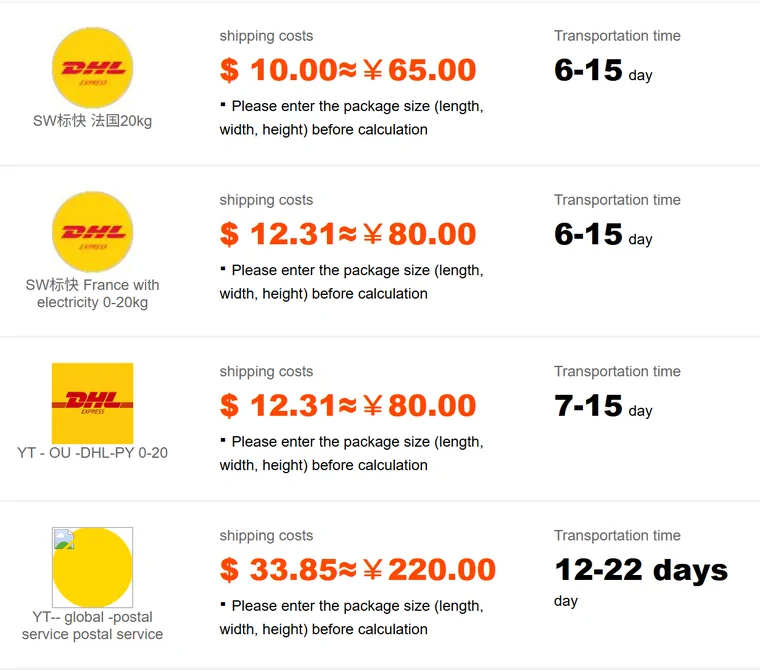
For a find shipped by itself, that first step is a floor: nothing lighter than 200 g costs less. The screenshot shows four French lines at 200 g, and each card is simply the first step of that line. For light finds the floor, not the find, decides the weight side, which is why the ship-alone reading of a small, dear item can still show the weight side in front.
On the postal family the floor is ¥170 to ¥270, which is larger than the service charge on any find with a charge base under ¥1,700. The dial shows the ship-alone reading by default because that is what Tigbuy’s quote shows for that weight when nothing else is in the box.
The per-gram reading, averaged over steps
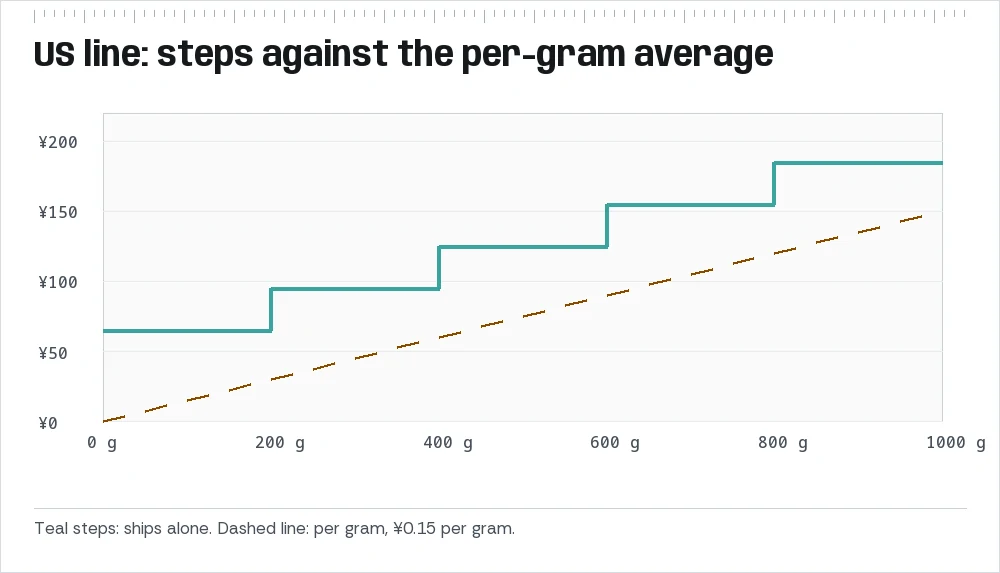
The per-gram reading takes the step price, divides it by the step size and multiplies by the weight. On the US line that is ¥0.15 per gram, so a 50 g find reads ¥7.50 and a 600 g find ¥90.00.
No parcel is ever billed this way: real parcels move in whole steps. The reading is a fair average of what a find adds by weight once the first step has been paid by something, and it is the reading the crossover is defined on.
Comparing the two readings for the same find shows how much of its ship-alone figure is first-step premium. For a 600 g find on the US line, ¥35 of the ¥125 ship-alone figure is premium; for a 50 g find, ¥57.50 of ¥65 is.
The per-gram reading also explains why one number can describe a whole line. Its weight side is a straight line through zero, so the ratio between the two sides depends only on the price per gram and never on the weight itself. Double the grams and double the price, and the needle stays put. The ship-alone reading does not have that property, because the first step sits under every parcel.
Switch the dial between the two readings and watch the weight bar. For heavy finds it barely moves; for light ones it shrinks to a sliver. The size of that jump is the first-step premium for that find on that line.
Customs and duties sit outside both sides
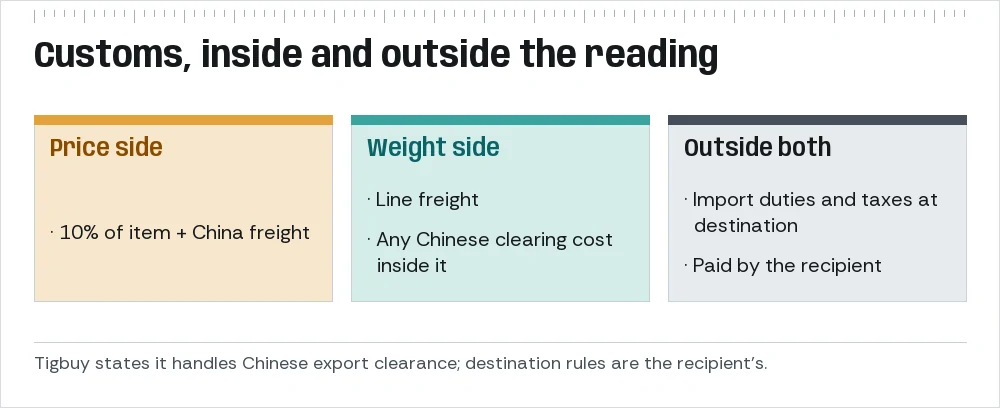
Tigbuy’s customs and tax page says it guarantees clearance at Chinese customs and takes responsibility for problems there. Import duties and taxes in your country are another matter: the recipient is the importer, and those charges sit outside both the item price and the line freight.
Tigbuy’s fee pages describe international freight as covering weight, delivery method and customs clearing charges. In the quotes we read, no separate customs amount was listed, so whatever clearing cost there is sits inside the line price and inside the weight side.
Any duty your own customs service charges on arrival is therefore a third amount, outside both sides of the reading. Its rules depend on where you live and on what the item is, and this guide does not estimate it.
Tigbuy’s customs page itself asks buyers to check their own country’s rules before buying. If a parcel is held at your border, the delay and any charge come from your customs service; they are not part of the line price and they do not change the reading of the find.
Line limits and the weight you only know at the warehouse
Every line has a weight limit, from a few kilos on some SW lines to around twenty on others, and the dial refuses a weight above the limit of the line you pick. Some SW lines also switch to billing by box size when the box is large; on those, the weight side can be larger than the actual grams suggest.
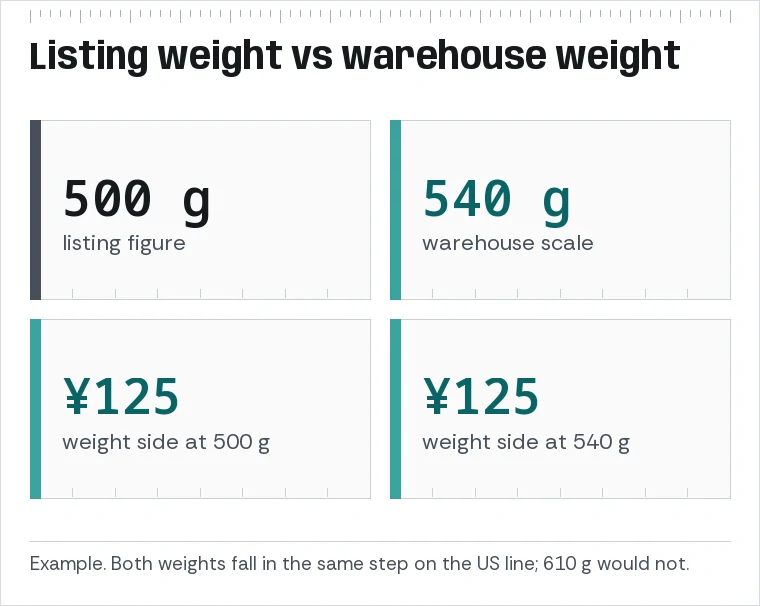
The gram figure that freight is billed on comes from Tigbuy’s scale after the item arrives, not from the listing. A listing that says 500 g can arrive at 540 g in its packaging, and on a 200 g step that may or may not cross a step boundary.
Re-run the dial on the warehouse weight before you choose a line. The weighing step itself is described on QC, weighing and arrival.