Using Tigbuy with the spreadsheet: the agent, the steps and the limits
The agent behind the readings: who runs it, the order of steps from link to parcel, and where its way of charging helps or does not.
What Tigbuy is
Tigbuy works as a buying agent on Chinese marketplaces. It buys for you on Taobao, Weidian, 1688 and JD, has the goods delivered to a warehouse in China, checks and weighs them, and ships them abroad on a line you choose. You pay in your own currency; the prices underneath are in yuan.
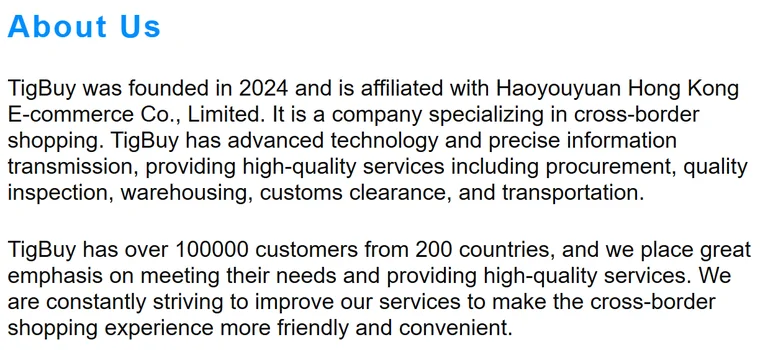
Its About page describes it as a cross-border shopping company and says it was founded in 2024. Its Contact page puts the operator at a Kowloon address in Tai Kok Tsui (Haoyouyuan Hong Kong E-commerce Co., Limited) and warns that parcels cannot be returned there. Hong Kong law applies to Tigbuy’s terms of service.
The company name is spelled in more than one way across Tigbuy’s documents. This guide uses the Contact page version, because that page also carries the registration details.
How a Tigbuy order moves through seven stages
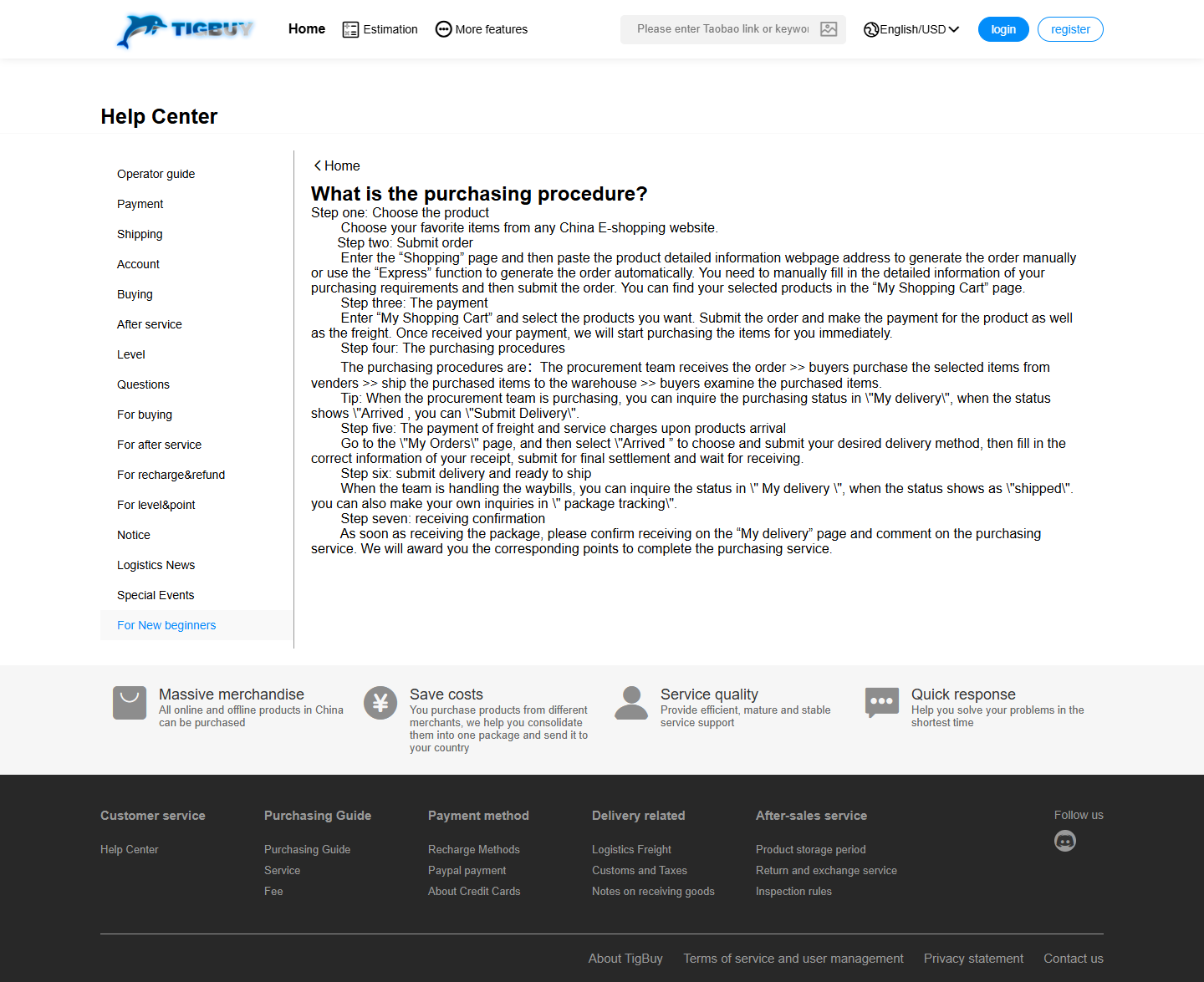
The order below follows Tigbuy’s purchasing-procedure article as captured on 17 October 2026. Each stage needs a different check; calculating a shipping estimate is preparation, not proof that a product can be sent.
- Select the product. Confirm the seller’s exact item, size, colour and availability. Keep the listing link and any useful measurement chart.
- Submit the purchase request. Paste the link into Tigbuy, check imported details and use manual fields when necessary. Add remarks for anything the buyer must clarify.
- Pay for the order. Review the cart and domestic postage, then pay the purchase amount. Watch for stock or price changes reported by the purchasing team.
- Wait for purchasing and warehouse inspection. The seller ships to Tigbuy. Compare the arrival photos and recorded measurements with your requested variant before accepting an uncertain item.
- Settle delivery costs. Select the arrived items to send, enter the correct address, choose an available route and review freight, service charges and optional services.
- Submit and track the parcel. Follow packing and dispatch, then use the waybill number for tracking. The seller-to-warehouse shipment and international parcel have different tracking stages.
- Inspect and confirm receipt. Record any damage or missing contents before discarding the packaging. Contact the agent promptly when you need after-sales help, then confirm receipt when appropriate.
Warehouse and arrival checklist · Where to ask about an order
The product decision and parcel decision happen at different times
First submit a precise buying request and review the item, domestic delivery and applicable purchase charges. Watch for questions about stock, price or options before assuming the seller has shipped. The seller-to-warehouse trip is a domestic stage, even when you are placing the order from abroad.
On arrival, review QC and deal with an eligible return before packing. Then choose which items will travel together, what protection they need and an appropriate international service. Keep a separate budget for freight, conversion or payment charges, selected extras and applicable destination costs. Consolidation can reduce repeated fees but may increase volume or restrict the line choice. Compare a complete delivered purchase, not only the ratio shown by the tool.
Why Tigbuy, and what every agent has in common
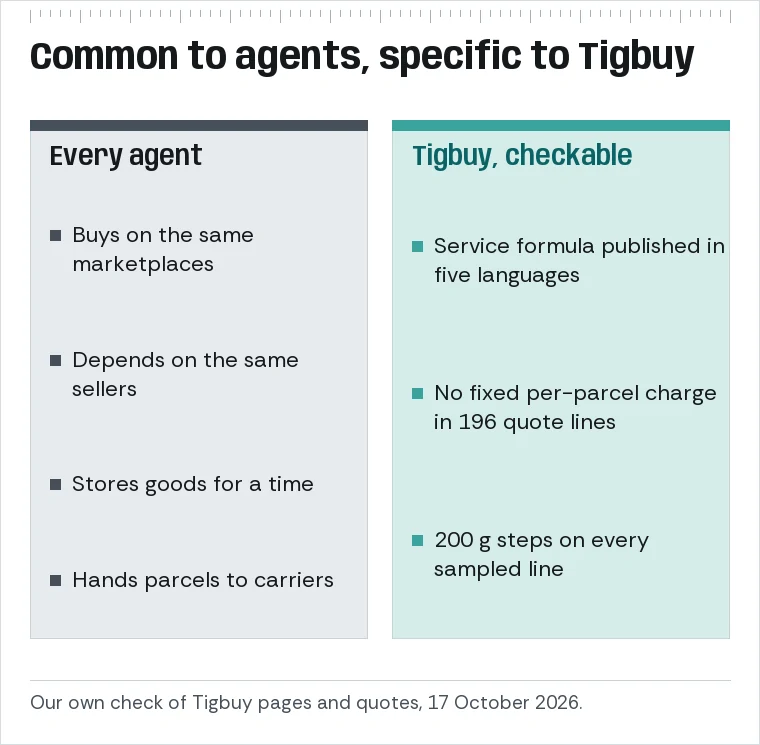
Start with what is the same everywhere. Any shopping agent buys from the same marketplaces, waits for the same sellers to ship, stores your goods for a while and hands them to international carriers. None of them controls the seller’s quality, and all of them earn on some mix of service charges and freight.
What is different at Tigbuy is narrow and checkable. Its service charge formula, ten percent of item price plus China freight, is published, and the same formula appears in five language versions of its fee page. Its quotes on 17 October 2026 carried no fixed per-parcel charge on any of 49 country-lines. And every sampled line used the same step size, 200 g, which keeps the weight side easy to reason about.
Those three facts are what make a price-per-gram reading work cleanly here. They do not make Tigbuy right for everyone, and the section below says where it falls short.
When a different agent may suit you better
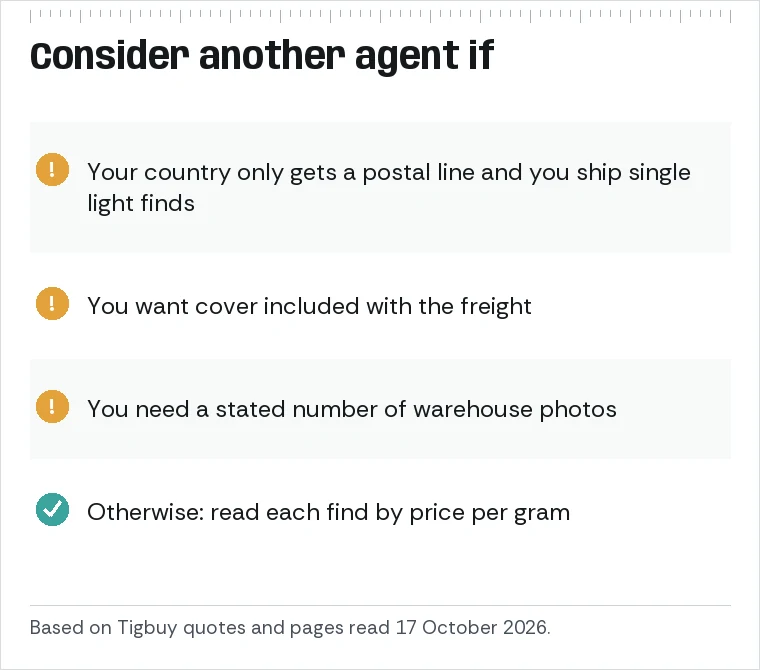
Use another agent when Tigbuy’s line list does not work for you. For Canada, Australia and Brazil the estimator offered only a postal line with a first step of ¥170 or more, so a single light find costs at least that to send. If you usually ship one small item at a time to one of those countries, compare what other agents offer there.
Look elsewhere too if you want insurance included with the freight. None of the lines we sampled came with free cover; Tigbuy’s cover is a paid plan you add when submitting a parcel. And if detailed photo packages matter to you, note that Tigbuy’s public pages do not say how many photos come with its warehouse check or what extra ones cost.
Whichever agent you use, the price-per-gram idea still works, as long as its quotes have no fixed charge in the middle. Where they do, add that charge as a third amount.
Agents that place their charges elsewhere
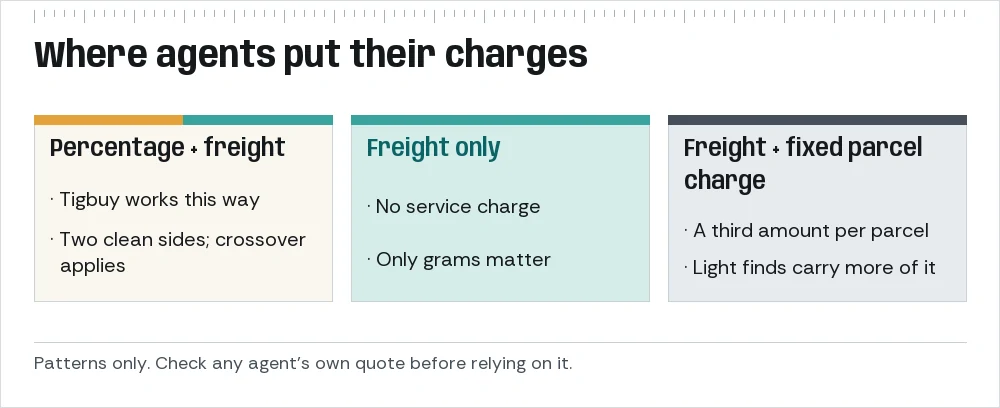
Catalogues like this one often mention several agents, and you will see other shopping agents named in guides, videos and forums. They do the same basic job and differ mostly in where they put their charges. Some take no service charge at all and earn on freight. Some add a fixed handling or operation charge to every parcel. Some show a discounted freight figure next to a crossed-out one.
Those differences change how a price-per-gram reading behaves. With no service charge, the price side disappears and only grams matter. With a fixed parcel charge, part of every quote belongs to neither side, so a light find carries more of it. With discounted figures, use the price you will actually pay.
We do not compare agents on this site or rank them. If you are weighing Tigbuy against another agent, find out where each one puts its charges, then run the same find through both.
What Tigbuy says about authenticity
Tigbuy’s Anti-Counterfeiting Policy puts it in one line:
The sale of non-authentic products is strictly prohibited.
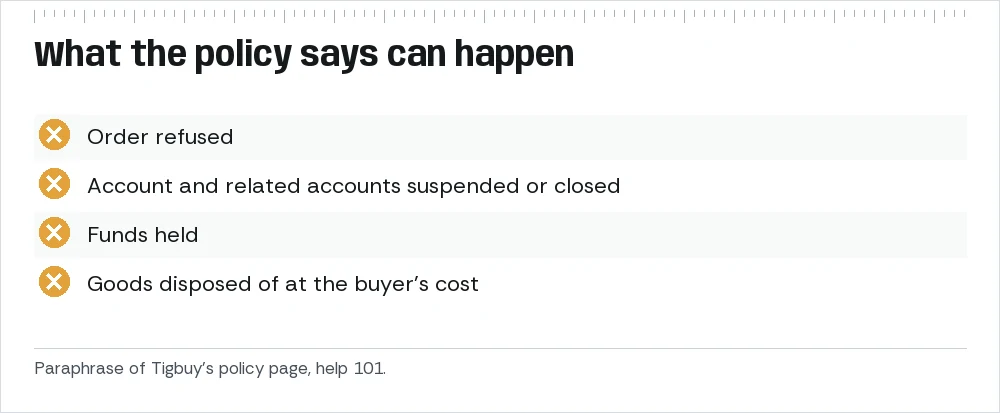
That policy goes on to list the consequences: refused orders, frozen or closed accounts (related accounts included), withheld funds, and disposal of non-authentic goods paid for by the buyer. A separate page on counterfeit and substandard goods describes cancelling such orders, by the user or by Tigbuy. Its terms also say it cannot vouch for every third-party item it buys.
This guide does not help anyone get around those rules. It reads prices and grams, nothing more.