QC, weighing and arrival: where the real gram figure appears
The warehouse step is where a listing becomes a parcel with a real weight. Here is what Tigbuy checks there, what it does not, and how to read what comes back.
What the warehouse check covers
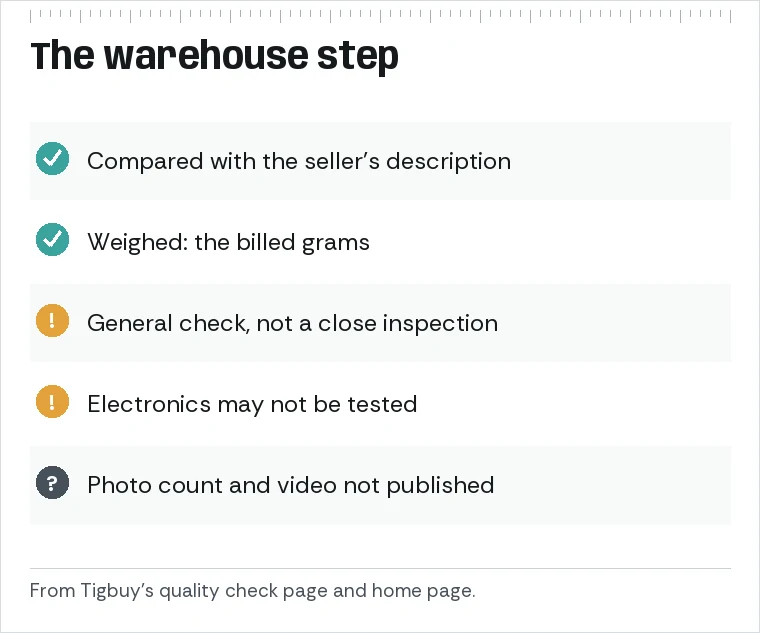
Once an item lands at Tigbuy’s warehouse, staff check it against what the listing says. Tigbuy’s quality check page is candid about the limits: it is a general look rather than a close inspection, and electronics may go untested since the staff are not technicians.
The same step includes weighing; Tigbuy’s home page lists quality inspection and weighing together, between arrival and international transport. For this site that weighing is the important part, because it produces the figure your freight is billed on.
Tigbuy publishes no figure for the number of photos taken at the check, no word on video, and no price for extra photos. Plan as if the check confirms the item and its basic condition, and nothing finer.
How to read the QC photos of a find
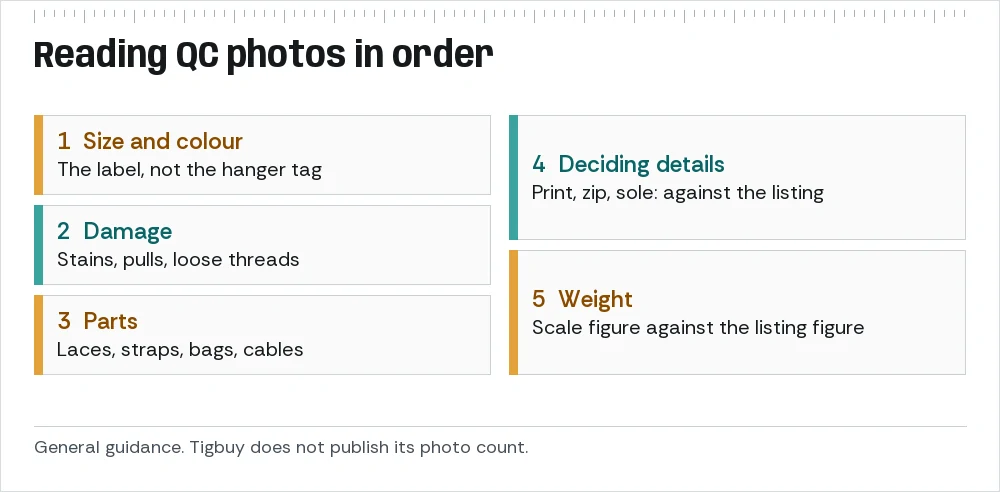
Whether the photos come from the warehouse or from the seller, read them in the same order. Start with the size label and colour, since a wrong size is the most common thing a general check would not flag as a problem. Then look for damage, stains or loose threads, and count the pieces: laces, straps, cables, spare buttons.
Next, compare the photos with the listing pictures for the details that decided your choice: a print, a zip, a sole pattern. A tape measure laid across the item is worth more than any adjective. If something is off, Tigbuy publishes a seven-day warehouse return-request window with exclusions and seller conditions, so raise the issue quickly and ask whether the item is eligible.
The seven-day policy is a request window, not blanket approval. Tigbuy lists exclusions including altered goods, missing parts, opened media and missing purchase proof. Ask support to confirm the seller’s conditions and return postage before sending an item back.
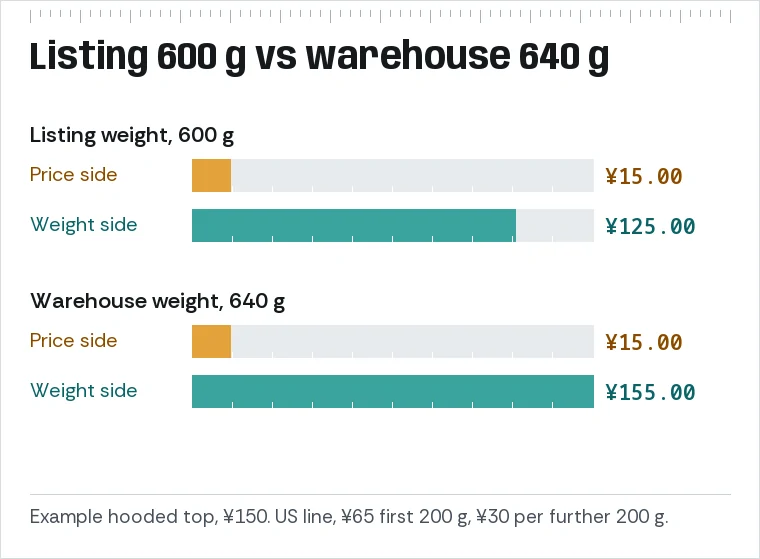
Finally, look at the weight. If a scale reading is shown or quoted, compare it with the listing figure and re-run your reading. A hooded top that was listed at 600 g and weighs 640 g has crossed into the next step on most lines.
- Size label and colour first
- Damage, stains and loose threads
- Every part counted
- Details that made you choose it
- Weight against the listing figure
Act quickly on anything doubtful. The seven days run from arrival at the warehouse rather than from when you first see the photos, so check your order page soon after the item is marked as arrived.
A measured weight cannot settle a sizing question
Check identity, quantity, label and visible condition first. For clothing, compare a useful garment measurement with the seller’s saved chart; for a bundle, check every included piece. A warehouse weight can help later costing but cannot show that the correct version arrived. Ask for a close-up or a specific measurement if an essential point is missing.
Photos do not authenticate goods or establish all functions. Report a mismatch under the item order while the applicable remedy remains available. Keep the response before changing packaging or submitting a parcel. Only after the item is accepted should you replace estimated freight inputs with the relevant packing measurements. The item’s scale weight and the parcel’s outer dimensions answer different questions.
The warehouse weight replaces the listing weight
A listing weight is a seller’s figure. Some sellers give the item alone, some give it in its packaging, some round to the nearest hundred grams. The warehouse weight is what Tigbuy uses, and it is the one to trust.
Take an example hooded top listed at 600 g and weighed at 640 g. On the US line, ships alone, the weight side moves from ¥125 to ¥155, because 640 g needs a third step. The price side does not move at all: it is still ¥15.00 on a ¥150 top.
The per-gram reading moves too, but smoothly: from ¥90.00 to ¥96.00. Price per gram falls from 0.25 to 0.23, so the find sits even further below the crossover.
Before you order: mistakes that move the reading
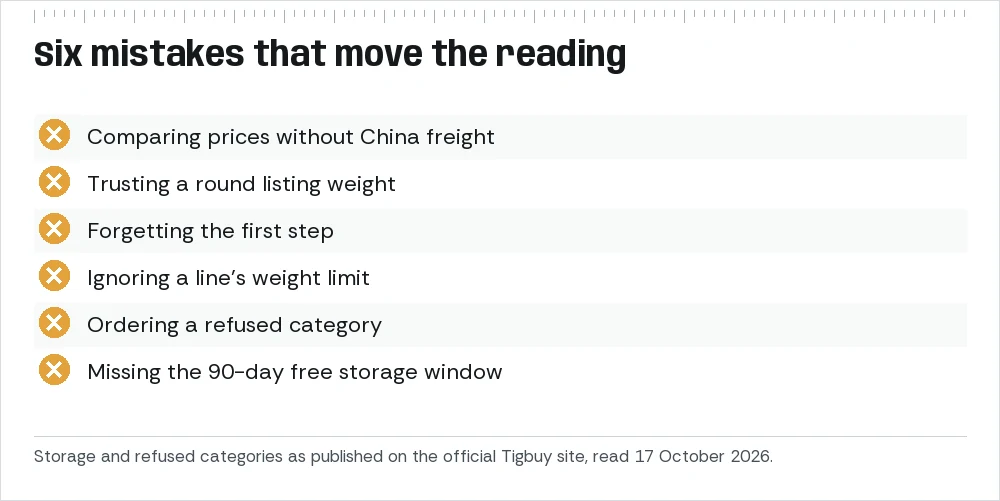
Most surprises on a Tigbuy order are weight surprises. These are the ones to avoid before you pay for the item.
- Reading the price without the China freight. The service charge is worked out on both, so compare listings on price plus freight.
- Trusting a round listing weight. “About 1 kg” can be 940 g or 1,080 g, and that is one step either way.
- Forgetting the first step. A light find shipped alone pays the whole first step of its line, which on postal lines is ¥170 or more.
- Picking a line without checking its limit. Some SW lines stop at a few kilos; the dial will refuse a heavier find.
- Ordering something Tigbuy will not handle. Its prohibited items statement lists categories it refuses, counterfeit goods among them.
- Leaving goods past free storage. Storage is free for 90 days; the price after that is not published.
None of these needs special tools. Writing the four numbers from the catalogue entry down before ordering catches most of them.
One more habit helps: run the dial before you pay for the item, not after. If the needle sits close to level, a small difference in weight or China freight will flip it, so that is the find whose listing weight deserves a question to the seller. If the needle is pinned at one end, the exact weight hardly changes which side leads, though it still changes the freight.
When the parcel reaches you
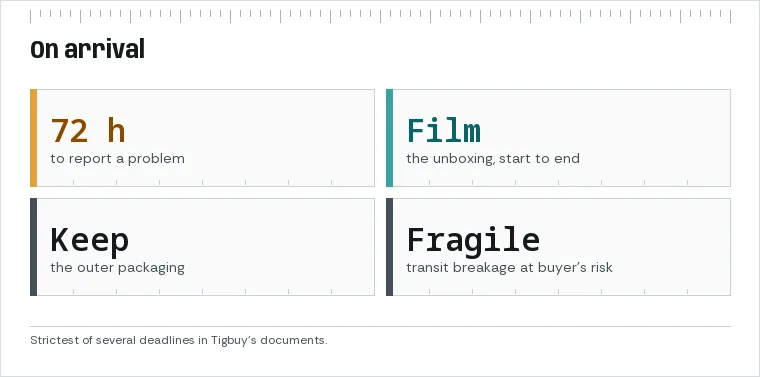
Tigbuy’s documents set more than one deadline for raising a problem after delivery; work to the tightest: contact Tigbuy within 72 hours of delivery, and film the unboxing from the start.
Hold on to the outer box and tape until every item has been checked. Under Tigbuy’s rules, breakage of fragile items in transit falls on the buyer, so packing options deserve a look when you submit a parcel.
Contact routes are on the Help page.