Density dial: set a price, a weight and a line, then read the needle
One find at a time. The needle shows which of Tigbuy’s two charges is larger for it, the bars show the yuan amounts, and nothing is added into a total.
Run the dial on a find
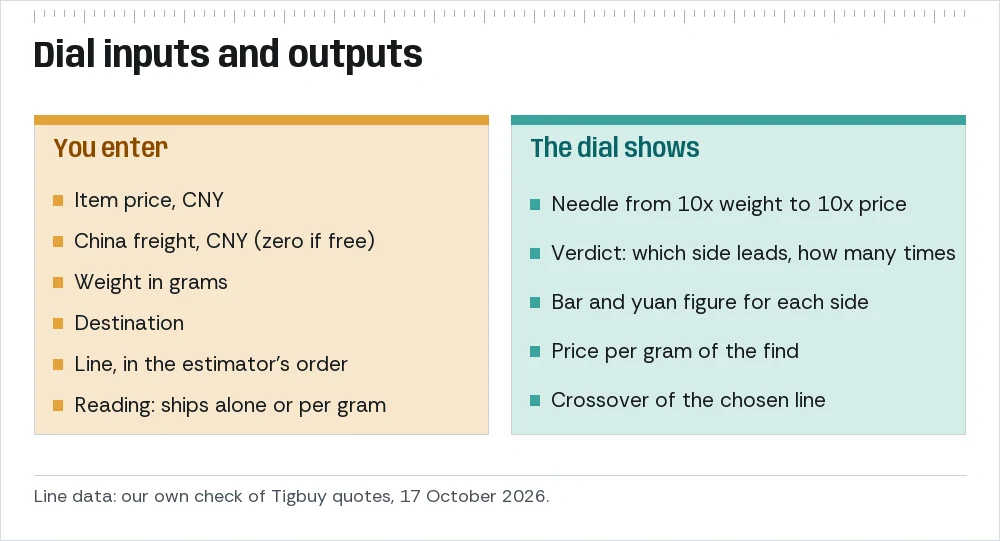
Prices in yuan as the listing shows them. Weight in grams. The line list follows the order Tigbuy’s estimator uses for that destination.
Set a price, a weight and a line.
The dial’s fields, one at a time
Here is how to use this tool with a real catalogue entry. Type the item price exactly as the listing shows it in yuan, for the colour and size you want. Put the seller’s delivery charge to the warehouse into China freight, or leave it at zero when the listing says free shipping. Both numbers go into the charge base, because Tigbuy calculates its ten percent on the two added together.
Weight is in grams. Use the listing figure for a first look and the warehouse figure once Tigbuy has weighed the item. Destination fills the line list with every line Tigbuy’s estimator returned for that country on 17 October 2026, numbered in the order it showed them. We did not reorder or rank them.
The needle and the verdict line say which side is larger and by roughly how much. The two bars give the yuan figures. Under them you get the price per gram of the find and the crossover of the line you picked, so you can see how far apart they are.
If you pick a weight above a line’s limit, the dial tells you and gives no reading for that line.
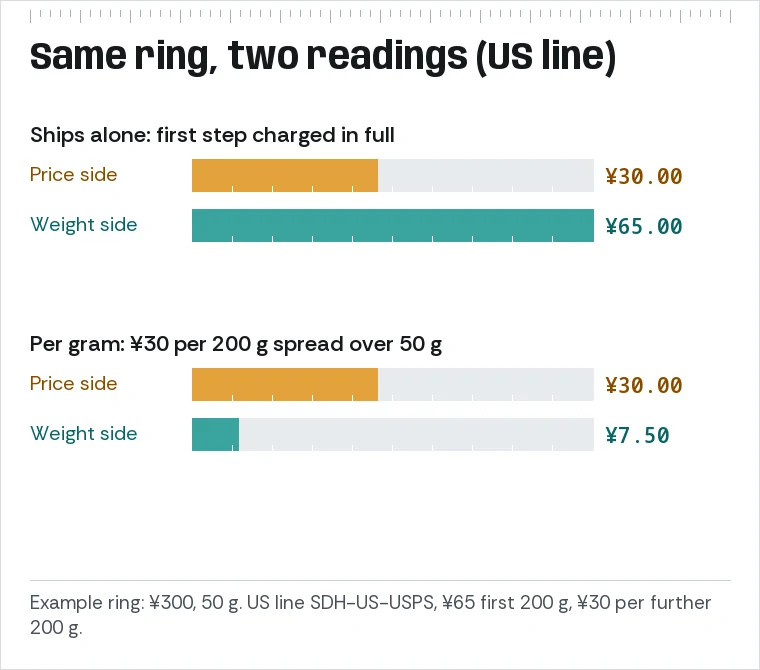
Ship-alone reading and per-gram reading
The two readings answer two different questions about the same find. Ship-alone asks what freight this one find would cost if it were the only thing in the parcel. It charges the full first step, then a whole step for any part of 200 g beyond it. That is the figure Tigbuy’s quote shows for that weight.
Per-gram asks what this find adds by weight once it travels with other things. It takes the step price, spreads it evenly over 200 g and multiplies by the find’s weight. In a real parcel the increase comes in whole steps, so adding a 50 g find can cost nothing extra or a full step, depending on where the parcel weight already sits.
For heavy finds the two readings agree on which side leads. For light finds they can disagree, and that disagreement is useful: it tells you the first step, not the find, is what you are paying for.
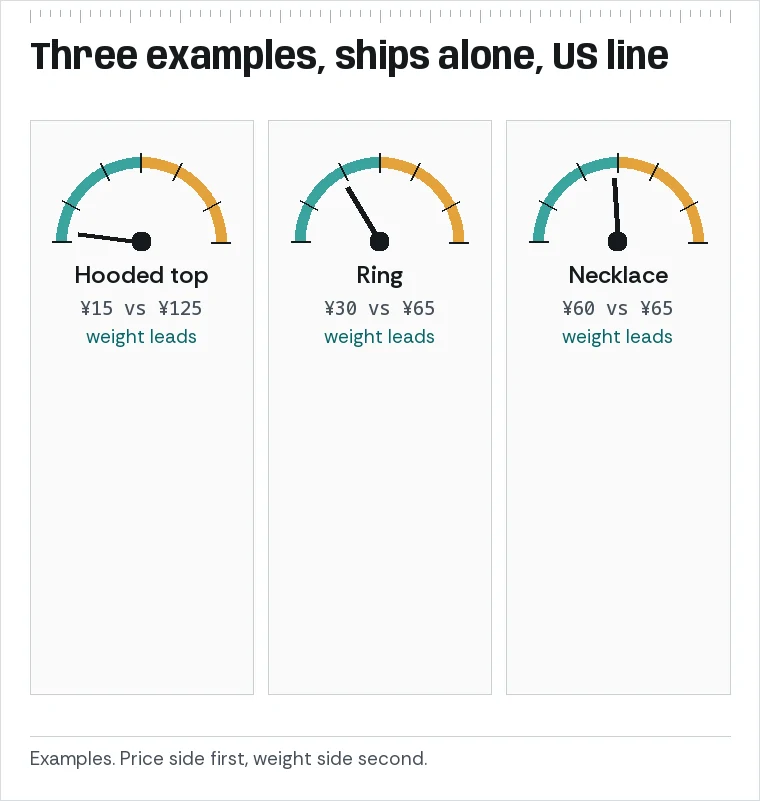
Three worked examples on the US line
All three are examples on SDH-US-USPS, the one line Tigbuy’s estimator offered for the United States: ¥65 for the first 200 g and ¥30 for each further 200 g, a crossover of 1.50 CNY/g.
Hooded top, ¥150 and 600 g. Price side ¥15.00. Ships alone: 200 g plus two steps, ¥125.00, about 8.3 times the price side. Per gram: ¥90.00, six times. The weight side leads either way.
Ring, ¥300 and 50 g. Price side ¥30.00. Ships alone: the first step, ¥65.00, about 2.2 times the price side. Per gram: ¥7.50, so the price side leads four times over.
Necklace, ¥600 and 80 g. Price side ¥60.00 against a ship-alone ¥65.00: nearly level. Per gram the weight side is ¥12.00 and the price side leads five times.
What the dial leaves out on purpose
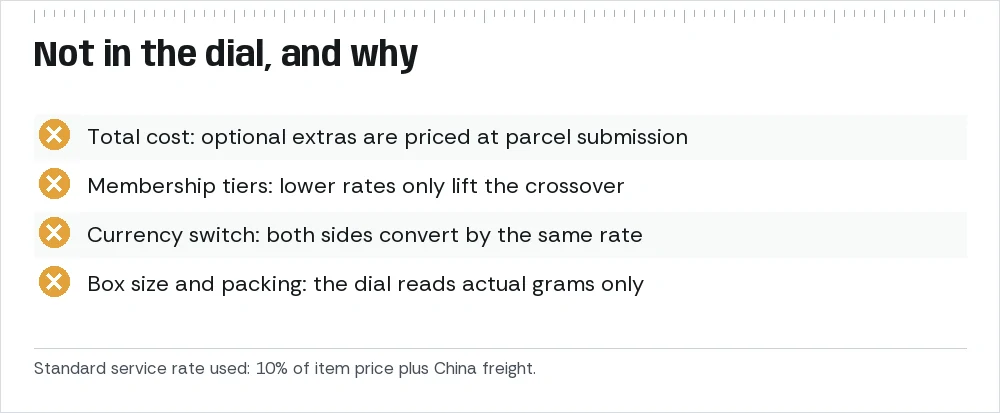
There is no total. Adding the two sides to the item price would turn a reading into a cost estimate, and the parts it would leave out, such as packing options or optional insurance, are priced only when you submit a parcel.
There is no membership selector. The dial uses the standard ten percent. Tigbuy lists lower rates for its Gold, Platinum and Diamond tiers, which would shrink the price side and push every crossover up.
There is no currency switch. Both sides are in yuan, and converting both by the same rate would not move the needle at all; Price side explains why.
There is no box-size field, and no advice on combining or splitting parcels. The dial reads one find on actual grams, nothing more.
Checking the dial against Tigbuy’s own figures
The ship-alone reading uses the same rule as the estimator page’s own script: first-step price, plus the step price times the number of steps beyond the first, rounded up. At 200, 500, 1,000 and 2,000 g it matched all 196 quote lines from our 17 October 2026 re-read to the fen.
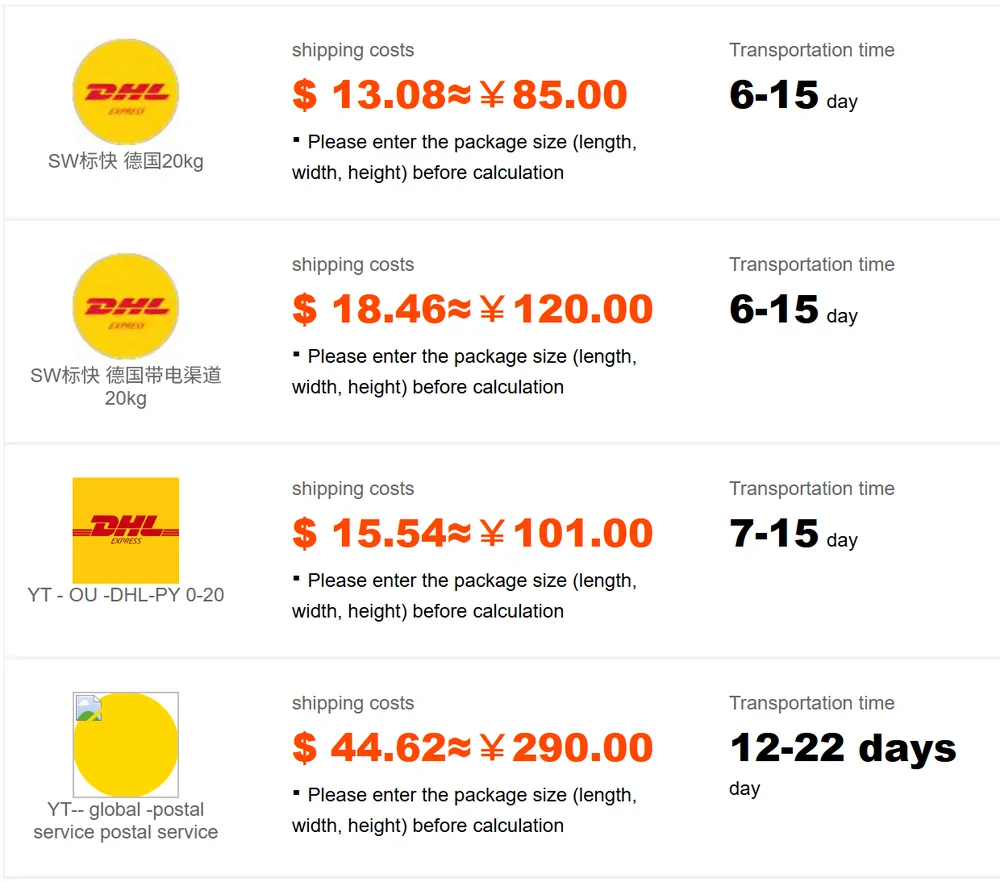
The screenshot is Tigbuy’s estimator for Germany at 500 g in a small box, with the four lines it offered. Type 500 g and Germany into the dial and the four ship-alone weight sides are the same: ¥85, ¥120, ¥101 and ¥290. The figures in the screenshot are Tigbuy’s own example quotes for that day.